Friction and transfer
Straps, collars, gloves and hands remove more protection during a long session than sweat does. Here is the map of where it happens and what survives it.
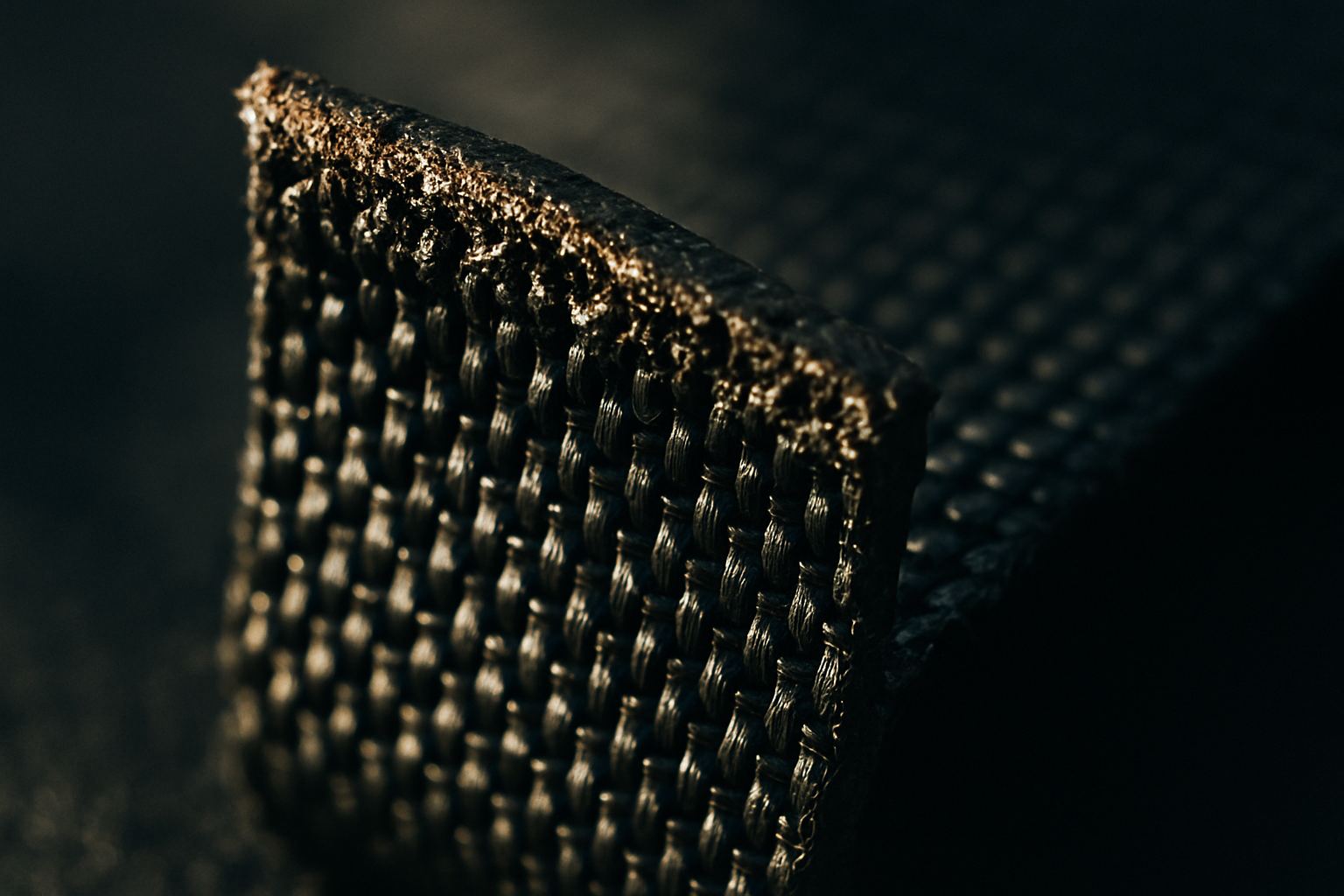
Any place where kit touches skin and moves against it is a place where protection is being mechanically removed and deposited onto the kit. Helmet straps, cap bands, collars, rucksack straps, glove cuffs, watch straps and glasses arms all produce clean stripes of unprotected skin. The reliable response is to cover the friction line with cloth rather than to keep treating it, because a strap will win against any film given enough hours.
Take a dark helmet strap off after a long summer ride and look at the inside of the webbing. There is a pale film on it. That film was on your face. The same is true of the inside of a collar, the underside of a rucksack shoulder strap, the palm side of a glove cuff and the back of a watch strap. Every one of those is a small, patient abrasive machine that has been running for the whole session.
This is the part of the sweat problem that gets least attention, and it is the part that does the most damage on long days. Sweat mobilises a film. Friction removes it entirely, and removes it in a shape: a stripe, a band or a patch that corresponds exactly to a piece of equipment. If you have ever seen a strap outline in a tan on a cyclist's face at the end of a season, you have seen the evidence of hundreds of hours of this.
The friction inventory
Every sport has its own set. Before you plan anything, do the inventory for your own kit. Put the kit on, move the way you move in the session, and note every point where something rests on skin and travels across it. The list is usually longer than people expect.
| Discipline | Friction points | Shape of the loss | What holds |
|---|---|---|---|
| Road and mountain cycling | Helmet strap, glasses arms and pads, collar, glove cuff, mitt edge | Stripes across cheek and jaw, patches at the temple, a band at the wrist | Cap under the helmet, a collar, full-finger cover on long days |
| Running | Cap band, headphone bands, watch strap, sports bra straps, sleeve edge | A band at the hairline, a rectangle at the wrist, lines at the shoulder | A brow band, sleeves rather than treated skin |
| Hiking and hill | Rucksack shoulder straps, hip belt, hat band, pole strap, collar | Wide stripes at the shoulder and neck, a band at the wrist | Long sleeves, a brimmed hat, a collar worn up |
| Climbing | Harness leg loops, helmet strap, rope drag on the forearm, chalk | Patchy removal on the forearm and neck | Sleeves, and accepting the hands are a lost cause |
| Racquet and field sport | Wristbands, headbands, collar, sock line, shin pad top | Bands at the wrist and brow, a line at the collar | Collars up, sleeves where the rules allow |
| Outdoor work | Hard hat harness, chin strap, hi-vis collar, glove cuff, tool belt | Stripes at the brow and neck, a hard line at the wrist | Cover specified as part of the task, not left to the individual |
Chalk, tape, grips and the invisible removers
Some sports add abrasives that are easy to overlook. Climbing chalk is one, and it removes product from hands and forearms very effectively while also drying the skin. Tape does the same and takes a layer with it when it comes off. Racquet and club grips are effectively sandpaper for a palm across a two hour session. Rowing and gym work on an outdoor rig behave the same way.
None of this is a reason for despair, and it is not a reason to try harder with product. It is a reason to stop expecting the palms and the inside of the fingers to hold anything at all, and to move the attention to the back of the hand, the wrist and the forearm, which are the surfaces actually presented to the sun in almost every sport.
| Surface | Angle to the sun | Exposed for | What removes protection | Control that holds |
|---|---|---|---|---|
| Cheek and jaw | Side-on to a high sun | 2-4h | Helmet strap sliding with head movement and sweat | A thin cap under the helmet does not help here, so this is a reapplication point at a stop |
| Temples | Side-on, partly shaded by the helmet | 2-4h | Glasses arms, helmet retention cradle | Cover with a cap band, or accept and reapply |
| Back of the neck | Steep, and the rider never sees it | 2-4h | Collar movement, jersey neckline, sweat running down | A collar worn up, or a cap with a neck flap |
| Wrist and forearm | Rotating, and forward-facing on the drops | 2-4h | Glove cuff, watch strap, mitt edge | Arm cover, which also removes the tan line problem |
| Back of the hands | Directly upward on the tops | 2-4h | Grip, glove movement, wiping | Full-finger gloves or cover, since product does not survive a bar |
Why covering beats treating at a friction line
A film on skin is a consumable. Under a strap it has a service life measured in tens of minutes, not hours, because the strap is doing exactly what a cloth does when you deliberately remove something. Reapplying under the strap is possible but it means loosening or removing equipment, and on a helmet that has a safety consequence, so in practice it does not happen.
Cloth behaves differently. It does not migrate, it is not removed by rubbing against another piece of cloth, and its performance at the end of four hours is close to its performance at the start. That is the entire argument for treating garments as the primary control in any sport lasting more than an hour, and it is why the section on kit is one of the largest on this site.
There is one qualification worth stating plainly. Not all cloth is equal, and a garment sold for a hot day may be thin, open and stretched over skin, all of which reduce what it does. Garments carrying a marked ultraviolet protection claim are assessed against a defined European standard for how such claims are made and marked, which is a more useful signal than the thickness of the fabric in your fingers.
Water resistance and abrasion resistance are unrelated properties. A formulation can behave well when wet and still be removed in seconds by a webbing strap, because one is about a film holding together against water and the other is about a film surviving mechanical shear.
This is why the friction map matters more in land sport than any product characteristic. Nothing you can apply is designed to survive being rubbed by nylon for four hours, and no label claims it is.
Building it into a session
- Do the kit inventory once, properly, for each discipline you do. It takes ten minutes and does not need repeating until your kit changes.
- For every friction line, decide one of three things: cover it, accept it and reapply at a known stopping point, or accept it and manage it before and after the session.
- Never leave a friction line in the fourth category, which is pretending it is protected because you applied something to it three hours ago.
- Check the kit itself. A pale film on the inside of a strap after a session is confirmation that the loss is happening, and roughly where.
- Re-run the inventory when you change a helmet, a pack or a job, because the lines move.
The pattern is consistent across every discipline covered on this site. The surfaces that fail are not the ones people worry about. They are the ones under a strap, behind a collar, at the top of a glove and on the back of a neck, and they fail on a schedule set by equipment rather than by weather.
Questions
Can I reapply under a helmet strap mid-ride?
Not without loosening or removing the helmet, which has a safety consequence and in practice means it does not happen. Treat the strap line as a friction line to be managed at a genuine stop or accepted, and put the effort into the surfaces you can actually reach.
Does the film I see on the inside of a strap mean the product is faulty?
No. It means it did what it was designed to do, which is sit on the outermost layer of skin, and then that layer was mechanically wiped by a moving strap. Every film behaves this way under shear.
Are gloves worth it purely for sun protection?
For long days on a bike, on a hill or at work, cover on the back of the hand is far more durable than anything applied there, because the palm side is constantly gripping something abrasive and the back of the hand is the surface actually facing upward.
Why do my forearms tan in a strange pattern?
Because a sleeve edge, a watch strap and a glove cuff all sit at fixed points while the forearm rotates through a wide arc. The pattern is a record of your kit rather than of your effort, and it is one of the most useful pieces of feedback you have about where cover is and is not working.
Does a rucksack protect the shoulders it covers?
The area genuinely under a strap or panel is shaded, but the strap moves, so the edges get the worst of both: partial cover and constant abrasion. On a hot hill day a long sleeve under the pack solves it in one move.
This article has no commercial links. Nothing in it is sponsored, no product is named and no payment of any kind was received for anything written here. Water Resistant SPF is published by Water Resistant SPF and recommends no products at all. Our funding is set out in full on the about page.
The session brief
One email a month on exposure, heat and sun protection for people who train outdoors and people who work outdoors. No product recommendations, because we do not make any. Each issue carries a single clearly labelled sponsor line that has no influence on anything above it.
We store your address to send the newsletter and nothing else. Unsubscribe in one click. See the privacy notice and the rate card.