Sweat is not immersion
Almost every question about sun protection in sport gets answered with guidance written for swimming. Sweat behaves differently, fails differently, and needs a different plan.
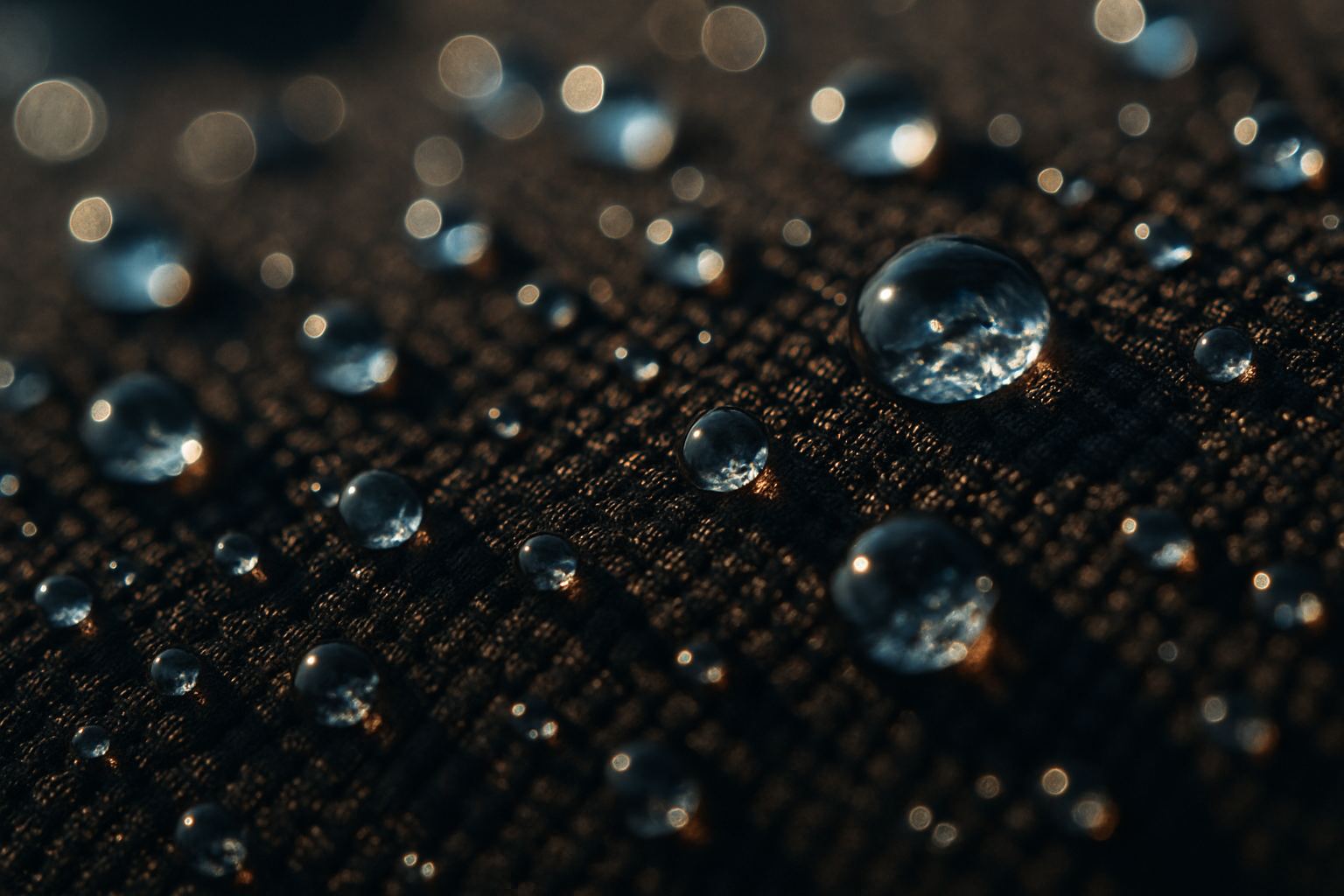
Immersion is a single event that acts on the whole covered surface at once. Sweat is a continuous, uneven output from the skin itself, so it works underneath a film rather than over it, concentrates at the forehead, hairline and the inside of every strap, and is combined with hours of friction from kit. That is why guidance built around swimming does not map onto a four hour hill day or a shift spent on a roof.
If you ask most people how to keep sun protection on during exercise, you get an answer that was written for a swimming pool. Reapply after towelling. Reapply after forty minutes in the water. Choose something labelled for water. The advice is not wrong, it is simply answering a different question, and the difference matters enough to be the reason this publication exists.
Immersion and perspiration are not two intensities of the same problem. They are two problems with different physics, different geography on the body, and different failure points. A runner on a two hour long run, a cyclist on a club ride, a groundsperson marking pitches or a hill walker on an exposed ridge all fail in the same characteristic way, and none of them fail the way a swimmer does.
Immersion applies water from the outside, all at once, to every surface that goes under. It ends when you get out. It is followed by mechanical removal, usually a towel, which is far more destructive than the water itself.
Sweat is produced from the skin outwards, continuously, at a rate that changes with effort and conditions, and it does not stop when you stop. It appears unevenly: the forehead and scalp are prolific, the forearms much less so. It runs downhill under gravity, so it collects at the brow, the bridge of the nose, the jaw and the inside of every band and strap.
Sweat is also salty, and it arrives with hours of movement. The problem in sport is rarely the water content of sweat on its own. It is the water content plus friction plus duration.
Four ways the two problems differ
1. Direction of travel
A film of sun protection sits on the outer layer of the skin. Immersion pushes against that film from above. Perspiration arrives from below, emerging through pores that are underneath the film, so it lifts and floats the product rather than washing it off. That is why sweat tends to move protection sideways and downwards into creases, hairlines and eyes, while immersion tends to thin it more evenly across a whole area.
2. Distribution
Immersion is democratic. Everything below the waterline gets the same treatment. Sweat distribution is not even remotely uniform, and it is not uniform between people either. The head and torso are heavy producers, the limbs less so, and everyone has their own pattern. The practical consequence is that the failure is local. Protection may be entirely intact on the outside of a forearm and completely gone across a forehead after the same hour.
3. What removes it
In the water, the destructive act is usually the towel. On land, the destructive act is your own kit and your own hands. A helmet strap crossing the cheek, a cap band across the forehead, a collar rubbing the back of the neck, a rucksack strap on the shoulder, a glove wiping a brow, a sleeve dragged across a face. Each of these is a small mechanical wipe repeated dozens or hundreds of times in a session.
4. Duration
Swimming sessions are usually bounded. Land sport routinely runs far longer, in the open, at the exact hours when solar radiation is at its strongest, with no shade and no natural point at which anybody stops to reapply anything. A round of golf, a sportive, a hill day or a day laying slabs can sit in the open for the whole of the middle of the day.
| Surface | Angle to the sun | Exposed for | What removes protection | Control that holds |
|---|---|---|---|---|
| Forehead | Near vertical to a high sun | 0-30 | Sweat running down, cap band, wiping with a hand or sleeve | A brow band or peaked cap that catches sweat before it reaches the eyes |
| Back of neck | Steep, and unseen by the wearer | 60-120 | Collar movement, rucksack strap, repeated head rotation | A collar or a cap with a neck flap |
| Ears | Side-on, both surfaces | 2-4h | Strap edges, glasses arms, hair movement | Covering, because product is very rarely reapplied here |
| Forearms | Rotating through the full range as they swing | 2-4h | Sleeve edge, watch strap, wiping | Sleeve length chosen for the day rather than the temperature |
| Lower lip | Presented forward and upward | 60-120 | Drinking, licking, wiping, eating | A dedicated lip product, reapplied at every drink stop |
Why the confusion is so persistent
Part of the reason is labelling. Products carry claims about behaving in water, and those claims are assessed by defined laboratory procedures. We deliberately do not cover those test methods here, because that is a subject in its own right and it is covered thoroughly elsewhere. What matters for our purposes is a simpler point: a claim about water is a claim about water. It is not a claim about six hours of friction under a rucksack strap, and it was never designed to be.
The second reason is that sweat is invisible in a way immersion is not. You know when you have been in the sea. You do not always register that you have been perspiring steadily for ninety minutes, especially in cool air, in wind, or at altitude where sweat evaporates before it is ever felt. Cyclists in particular can be losing a great deal of fluid without feeling wet at all, because the airflow removes it as fast as it appears.
The third reason is that the swimming answer is comforting. It gives a rule: reapply every so often. In land sport that rule collides with the fact that most people cannot stop. A tennis match runs to a fixed schedule. A team sport runs to a referee's watch. A group ride does not pause for anybody. The plan therefore has to survive the session rather than depend on interrupting it.
We describe how exposure works and what tends to hold. We do not diagnose, we do not name products, and we do not give clinical advice. If you have a mole, a mark or a patch of skin that is changing, or if anybody is unwell in the heat, that is a matter for the NHS, a GP or, where it is genuinely urgent, 999.
What follows from the distinction
Once you separate the two problems, the priorities reorder themselves. If the failure is local, uneven and driven by friction and duration, then the first control is not the thing you spread on your skin. It is what you wear, because a sleeve does not migrate, does not sting the eyes and does not get wiped off by a strap. The second control is timing, because the sun is not constant through the day and most training sessions are movable. The third control is product, applied to what remains uncovered.
This ordering is not a fashionable opinion. It is the same hierarchy that occupational health guidance for outdoor workers has used for years: remove or reduce the exposure first, then use collective and physical measures, then rely on what goes onto the individual last. The Health and Safety Executive frames outdoor solar exposure that way for employers, and it transfers cleanly to sport, because a training block and a working week have far more in common than either has with an afternoon at the pool.
| Rank | Control | Why it sits here | What it does not solve |
|---|---|---|---|
| 1 | Shift the session | Nothing beats not being out under the strongest part of the day | Fixtures, work shifts and daylight in winter training |
| 2 | Cover the surface | Cloth does not migrate, sting or transfer onto a strap | Face, ears, hands, anything you will not cover |
| 3 | Use shade on the route | Free, and it works on every uncovered surface at once | Open moor, open water, open pitch, open site |
| 4 | Apply product to what is left | The last line, on the surfaces nothing else reaches | Anything you cannot reach again mid-session |
| 5 | Plan a realistic reapplication point | Better one that happens than four that do not | Sessions with no legitimate stopping point |
The test to apply to any advice you read
When you next see guidance about sun protection in sport, ask one question of it: was this written about water or about sweat? If the answer is water, it may still be useful, but it is answering a question about a swimmer, and you are not one. The exposure map for your sport, the friction points in your kit, the duration of your normal session and the hour of the day you normally train are the four variables that actually determine what happens to your skin, and none of the four appears anywhere in swimming advice.
Everything else on this site is an application of that idea to a specific case. Some cases are obvious, like a long cycle in July. Some are not, like an hour of weeding in April, which is the largest single dose many people get all year and which almost nobody counts as exposure at all.
Questions
Does sweat remove sun protection faster than swimming does?
It is not a race, because the two act differently. Immersion tends to thin a film across a whole submerged area and is usually followed by a towel, which removes far more than the water. Sweat works unevenly from underneath and is combined with hours of friction from kit and hands, so it produces local failures at the forehead, hairline, ears and every strap line while leaving other areas largely intact.
Is a product labelled for water good enough for a long run?
A water claim is a claim about water. It tells you something about how a formulation behaves when wet, and nothing about how it behaves under a cap band for two hours. Treat it as one input, not as a plan, and build the plan around cover, timing and the surfaces you can realistically reach again mid-session.
I do not feel sweaty when I cycle. Am I still losing protection?
Airflow evaporates sweat as fast as it is produced, so feeling dry on a bike tells you very little about how much you are producing. Cycling also holds one posture for hours, which concentrates friction at fixed points: the helmet strap on the cheek, the glasses arms on the temples and the collar on the back of the neck.
Should I reapply during a match or a race?
Where the format allows it, a change of ends, a half-time interval or a feed stop is a realistic point and worth using. Where it does not, the plan has to survive the whole session, which means covering what you can and accepting that the uncovered surfaces are the ones you will need to manage before and after rather than during.
Where does the phrase water resistant come from then?
It is a labelling term describing behaviour in water, evaluated by defined laboratory procedures. This site does not cover those procedures, and we do not use the phrase as if it described performance during exercise, because it does not.
This article has no commercial links. Nothing in it is sponsored, no product is named and no payment of any kind was received for anything written here. Water Resistant SPF is published by Water Resistant SPF and recommends no products at all. Our funding is set out in full on the about page.
The session brief
One email a month on exposure, heat and sun protection for people who train outdoors and people who work outdoors. No product recommendations, because we do not make any. Each issue carries a single clearly labelled sponsor line that has no influence on anything above it.
We store your address to send the newsletter and nothing else. Unsubscribe in one click. See the privacy notice and the rate card.