Snow and rock reflection
Under the chin, under the nose, the underside of the forearms, the roof of the mouth. Reflected ultraviolet reaches surfaces that no plan ever accounts for.
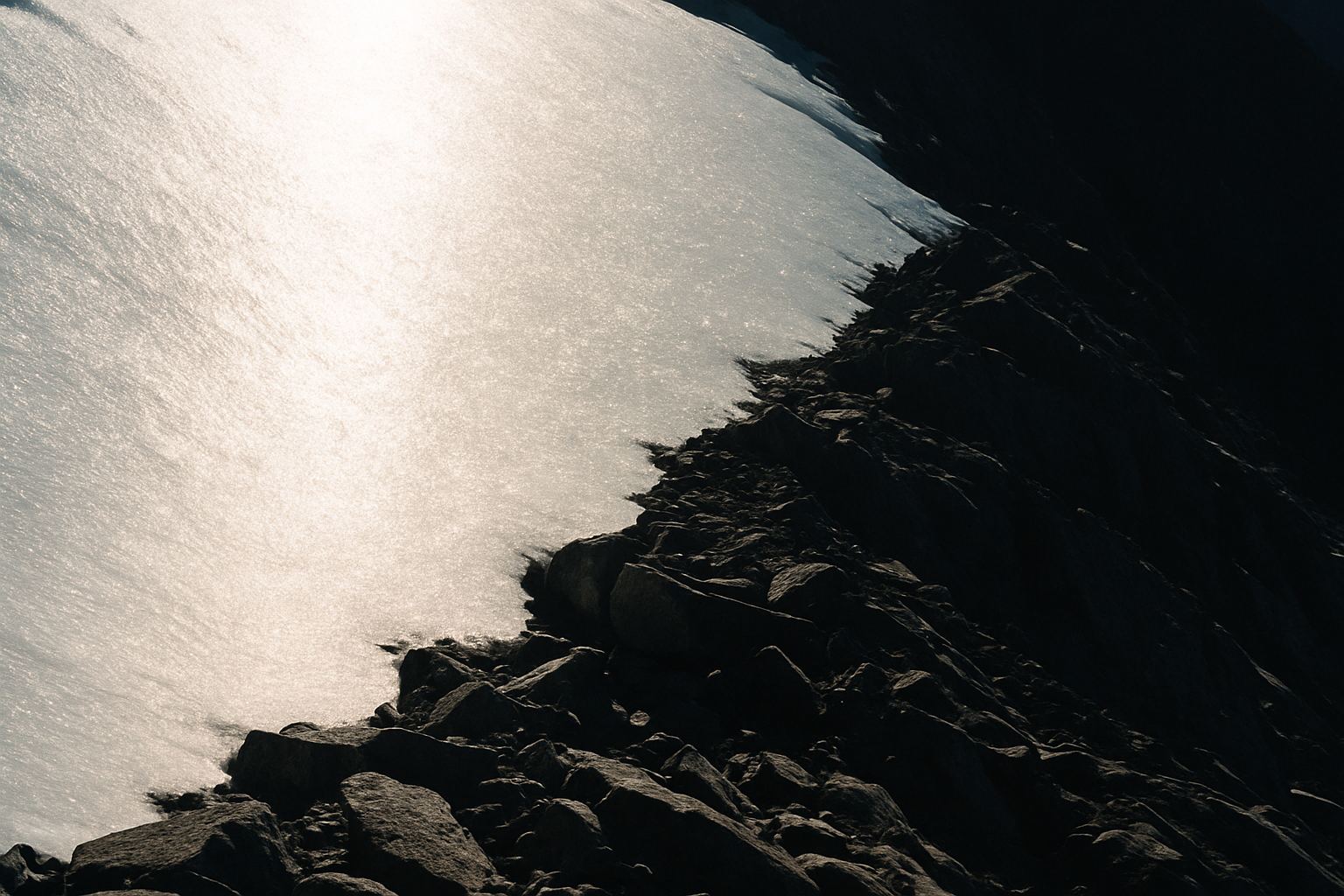
Ground surfaces reflect ultraviolet upward, and snow is the strongest common reflector, well ahead of pale rock, sand and concrete, with grass and dark tarmac at the bottom. The consequence is that surfaces facing downwards receive a load: under the chin, under the nose, the underside of the forearms and the eyes. Those surfaces need deliberate attention because no default plan includes them.
Every exposure plan people build assumes the sun is above them. Hats have brims, shoulders get the attention, the tops of the forearms get treated. On most surfaces that assumption is reasonable. On snow it is badly wrong, and on pale rock, dry sand, light concrete and water it is wrong enough to matter.
Ultraviolet arriving at the ground does not simply stop there. A proportion bounces back upward, and the proportion depends heavily on the surface. The World Health Organization's guidance on the ultraviolet index identifies fresh snow as the most reflective common surface by a considerable margin, with sand, water and pale concrete well behind it and grass, soil and dark tarmac lower still.
| Surface | Relative reflection | Where it matters |
|---|---|---|
| Fresh snow | The highest of any common surface | Winter hill days, ski touring, spring mountaineering, alpine approaches |
| Old or dirty snow | Lower than fresh but still substantial | Late season snow patches, ski resorts in spring |
| Dry pale sand | High | Beach running, coastal paths, dune training, links golf |
| Water | Varies sharply with sun angle, highest when the sun is low | Coastal routes, reservoirs, riverside paths |
| Pale concrete and light acrylic | Moderate to high | Hard courts, athletics tracks, urban training, building sites |
| Pale limestone and dry scree | Moderate | Crags, mountain paths, quarried ground |
| Grass and vegetation | Low | Pitches, parks, most field sport |
| Dark tarmac | Low | Road running and cycling |
The surfaces nobody protects
Reflection turns a set of body surfaces from irrelevant into exposed. They share one property: they face downwards or sideways, so nobody has ever thought about them.
| Surface | Angle to the sun | Exposed for | What removes protection | Control that holds |
|---|---|---|---|---|
| Under the chin | Facing straight down at the most reflective surface there is | 4h+ | Nothing removes it, it is never applied | Deliberate application. This is the classic snow burn |
| Under the nose and nostrils | Facing down and lit from below | 4h+ | Wiping a running nose in cold air | Deliberate application, repeated, because it gets wiped |
| Underside of the forearms | Facing down when poles are held | 4h+ | Pole straps, sleeve movement | Sleeves, which solve it entirely |
| Lips, lower more than upper | Facing forward and down | 4h+ | Eating, drinking, wind, wiping | A lip product with ultraviolet protection, reapplied often |
| Eyes | Receiving light from above and from the snow below | 4h+ | Goggles or glasses pushed up on a climb | Eyewear with genuine ultraviolet filtration, kept on |
| Ear lobes and under the jaw | Facing down and outward | 4h+ | Never applied | A deliberate habit, since no hat covers them |
Why the eyes matter most on snow
Skin recovers from a burn. Eyes exposed to a large ultraviolet load on snow can develop photokeratitis, which is a painful condition sometimes called snow blindness, and it is the reason eye protection is treated as mandatory rather than optional by anybody who works or travels on snow. It is not something to manage by squinting.
This site does not give clinical advice and will not describe treatment. What it will say is that eyewear with genuine ultraviolet filtration, in a wrap or with side coverage, worn for the whole time you are on snow rather than pushed up on your forehead during the effort, is the control. Anyone experiencing eye pain after a day on snow should speak to an optometrist, a pharmacist or a GP, and urgently if vision is affected.
Reflection off water is often discussed as a swimming issue, which misses the point for land sport. You do not need to be in the water to receive the reflected component from it.
A coastal path, a reservoir circuit, a links course or a riverside run all place you next to a reflective surface for hours. The load arrives on your face and the underside of your jaw while you stay completely dry.
Sand, concrete and the urban version
It is not only mountains. Dry pale sand reflects a good deal, which is why beach and dune sessions are more exposing than the same effort on grass. Pale concrete in an urban environment does the same, which matters for track athletes, outdoor gym users, tennis players on light acrylic and anybody working on a construction site surrounded by pale material.
The construction case is worth stating explicitly because it is occupational rather than sporting. A site with fresh concrete, pale blockwork, scaffolding boards and metal surfaces is a reflective environment, and the people in it are there all day, every day, for a season. That is a much larger total dose than any sport.
What to actually change
- When there is snow, sand, pale rock or water underfoot or alongside, add three surfaces to your application: under the chin, under the nose, and the underside of the jaw and ears.
- Wear eyewear with genuine ultraviolet filtration on snow, and keep it on rather than pushing it up during effort.
- Wear sleeves rather than treating forearms, because the underside is the surface you will otherwise miss.
- Use a lip product and reapply it. Lips receive both direct and reflected exposure and are the first thing lost.
- Recognise that a bright winter day on snow can present a real load despite the temperature, and that spring on lying snow is the worst combination of all.
Pain, grittiness, watering or affected vision after a day on snow needs professional attention rather than waiting it out. A pharmacist, an optometrist, a GP, or urgent care if vision is affected. We do not diagnose or treat anything here.
The general principle
The exposure map method asks what angle each surface presents to the sun. Reflection is the reminder that the sun is not the only source, and that on the right ground the sky effectively extends downwards. Once you have added the ground to the map, a whole set of surfaces that were previously ignored acquire an obvious control, and most of them are handled by two minutes of deliberate application and a pair of glasses.
Questions
Which surface reflects the most ultraviolet?
Fresh snow, by a clear margin over anything else commonly encountered. Dry pale sand, water and pale concrete follow, and grass, soil and dark tarmac are low. This ranking appears in the World Health Organization's guidance on the ultraviolet index.
Do I really burn under my chin on snow?
It is one of the most characteristic patterns of a day on snow, along with under the nose and inside the nostrils, because those surfaces face downwards towards the most reflective ground there is. Almost nobody applies anything there, which is why it happens so reliably.
Are sunglasses enough on snow or do I need goggles?
The requirement is genuine ultraviolet filtration plus coverage at the sides, because a large part of the load is arriving from below and from the side. Whether that is achieved by a wrap-around frame or by goggles depends on conditions, but a flat pair of open-sided glasses is not doing the job.
Does water reflect more when the sun is low?
Reflection off water varies sharply with the angle at which light strikes it and is highest when the sun is low, which is one reason early and late sessions beside water are less benign than the low sun angle suggests.
Is a building site a reflective environment?
Fresh concrete, pale blockwork, scaffolding and metal all reflect more than soil or grass, and the people on the site are there for full shifts across a whole season. It is one of the higher total exposures anyone in this country receives, and it is an employer's responsibility as much as an individual's.
This article has no commercial links. Nothing in it is sponsored, no product is named and no payment of any kind was received for anything written here. Water Resistant SPF is published by Water Resistant SPF and recommends no products at all. Our funding is set out in full on the about page.
The session brief
One email a month on exposure, heat and sun protection for people who train outdoors and people who work outdoors. No product recommendations, because we do not make any. Each issue carries a single clearly labelled sponsor line that has no influence on anything above it.
We store your address to send the newsletter and nothing else. Unsubscribe in one click. See the privacy notice and the rate card.